Showing posts with label Carroll Shelby. Show all posts

Tuesday, May 22, 2018

2018 Carroll Shelby Tribute

6th Annual Carroll Shelby Tribute.  Image Credit: 2018 Brandon O'Brien / Motor Driven Images

2018 Carroll Shelby Tribute
Words By: Brandon J. O'Brien
Images By: Brandon O'Brien / Motor Driven Images unless otherwise specified

It has been six year's since the passing of Carroll Shelby. Every year the Shelby American Organization has remembered him by hosting a tribute in his honor at the old Shelby Engine Production shop located in Gardena California.

An interested crowed of listeners gather around Cobra owners Hank Williams and Lynn Park, "Mr. Cobra" discussing the finer points of owning original Cobras.  Image Credit: 2018 Brandon O'Brien / Motor Driven Images

This year was probably one of the better years for having a nice representation of most of the models, both old and newer, made famous through Carroll Shelby's efforts.   If you are fan of Cobra's, Shelby Mustangs, or even GT 40's there was something there to peak your interest.  

The view many Corvette racers feared.  1964 289 Cobra, CSX 2355.  Image Credit: 2018 Brandon O'Brien / Motor Driven Images

1965 "427" Cobra, CSX3201 was the first of approximately 100 Cobras produced with the 428 Pl engine producing 385-hp. vs the 427's 425-hp.  Image Credit: 2018 Brandon O'Brien / Motor Driven Images

Beautiful Red 1966 Shelby GT 350, 6S743.  Image Credit: 2018 Brandon O'Brien / Motor Driven Images

2011 Shelby GT350.  Image Credit:  2018 Brandon O'Brien / Motor Driven Images

The "Bullitt" Prototype was on display at the 6th Annual Carroll Shelby Tribute.  Image Credit:  2018 Brandon O'Brien / Motor Driven Images

Not only is this time taken to focus on the man, his automobiles, and his Foundation it is also a time for Shelby American to show-case new vehicles it is producing at their Las Vegas production facility and announce new projects.

The current 2018 line-up of vehicles produced include the Shelby Super Snake, Shelby F-150, Shelby F-150 Raptor, F-150 Super Snake, and the Shelby 1000 Diesel.

2018 Shelby Super Snake on display at the 6th Annual Carroll Shelby Tribute.  Image Credit: 2018 Brandon O'Brien / Motor Driven Images

The Shelby Super Snake is newly revised for this year and can be optioned with a 800+ hp Carroll Shelby Engine.  The body has an all-new front fascia assembly including a new hood with divided hood grille and rockers to yield much improved under-hood cooling for the turbo's.  The model comes standard with a Shelby-tuned performance suspension with a track suspension available as an option.  Also available as an option is a widened body to accommodate enhanced tire width.

2018 Shelby F-150 as seen at the 6th Annual Carroll Shelby Tribute.  Image Credit: 2018 Brandon O'Brien / Motor Driven Images

The Shelby F-150 comes with a 755-hp Carroll Shelby Engine with direct fuel-injection. To accommodate all this power the truck comes with a sport-tuned suspension, 20 in. wheel/tire combination, and 10-speed transmission.  Visually the truck sports a Shelby designed hood, front grill, bumpers, and badging.

The F-150 Super Snake has all of the above features along with a lowered street suspension.

2018 Shelby F-150 Raptor on display at the 6th Annual Carroll Shelby Tribute.  Image Credit: 2018 Brandon O'Brien / Motor Driven Images

The Shelby F-150 Raptor,  designed for off-road use, has a 525-hp Carroll Shelby Engine and FOX 3" Raptor Stage 2 shock system and 6x wheels/tires.  Exterior changes include Shelby badging, Shelby Ram-Air hood, bumpers and chase rack along with interior upgrades.

The Shelby 1000 Diesel features 1000 lb/ft torque.  Enough to smoke the tires while pulling a trailer laden with a Shelby Super Snake.  The truck features both exterior and interior upgrades.

Two speciality cars were also on display and a third received it's world-wide unveiling.  The Original Venice Crew (OVC) Shelby Mustang GT 350 - Competition Model was announced in 2017.  On display was one of the two prototypes.  

Prototype OVC Shelby Mustang GT 350 - Competition Model on display at the 6th Annual Carroll Shelby Tribute.  Image Credit: 2018 Brandon O'Brien / Motor Driven Images

The idea was to build the cars as close to the way it was done in 1965 except for safety items and design features that Peter Brock had on his drawing board at that time but did not have the time or budget to consummate in 1965.  

Only 36 cars will be built by Shelby American and they can be ordered with either the solid rear axle as originally supplied or with the independent rear suspension that was being tested by Ford Advanced Vehicles in 1964/65.  Visual changes include a more efficient front fascia, rear quarter windows, rear brake ducts (both features became standard on the 1966 GT 350), and revised rear window glass without the hump.  Pricing is $249,995.00

The other car on display which had been unveiled earlier this month was the 1967 GT 500 Super Snake Continuation.  Only 10 of these will be produced.  These cars will be built with a special Carroll Shelby 427 engine, 4-speed transmission, Detroit locker, and upgraded interior.  They will be serialed with Shelby serial numbers reserved back in 1967.  Pricing was announced to be $249,995.00

1967 Shelby GT 500 Super Snake Continuation model on display at the 6th Annual Carroll Shelby Tribute.  Image Credit: 2018 Brandon O'Brien / Motor Driven Images

The world premier was of the most advanced Shelby American product to be produced to date.  Shelby American announced the limited production of the Shelby Series 2.  Visually based on the 1999 Series 1 this is an all new vehicle. Along with the Series 1 this is the only Shelby street vehicle that was designed from the ground up by Shelby American.  The new Series 2 will be made available either with an aluminum body (only one produced per year) or the "standard" carbon fiber body (limited to 3 per year).  

The unveiling of the Aluminum bodied Shelby Series 2 at the 6th Annual Carroll Shelby Tribute.  Image Credit: 2018 Brandon O'Brien / Motor Driven Images

Front view of the Aluminum bodied Shelby Series 2 unveiled at the 6th Annual Carroll Shelby Tribute.  Image Credit: 2018 Brandon O'Brien / Motor Driven Images

The buyer will have a choice of custom engine options from the Carroll Shelby Engine company attached to a 5 or 6-speed transaxle.  The suspension is based on the push rod system used in Formula 1.  All of this is mated to a honey comb aluminum chassis.  Pricing for the Carbon Fiber version will be $349,995.00 and the Aluminum bodied version will be $849,995.00.  Think of it this way - with such limited production, the value can only go up.   

In place of the Oldsmobile Aurora V8 Shelby American has been testing a Carroll Shelby Engine in Series 1 CSX 5249. Note the Formula 1 Push Rod front suspension components.  Image Credit: 2018 Brandon O'Brien / Motor Driven Images

The Tribute seems to get better each year.  This year there were more varied cars both on display, in and around the building and also along the street.  Assuming there will be a 2019 Tribute it will be held on May 18th.  It's not too early to put a reminder into your smart phone.


TAGS: Carroll Shelby, Carroll Shelby Tribute, Cobra, 289 Cobra, 427 Cobra, GT 350, GT 500, Motor Driven Images, Raptor, Shelby, Shelby Tribute, Shelby Series 1, Shelby Series 2, Shelby 1000 Diesel, Super Snake, Series 1, Series 2 


Tuesday, July 18, 2017

The Ford That Beat Ferrari

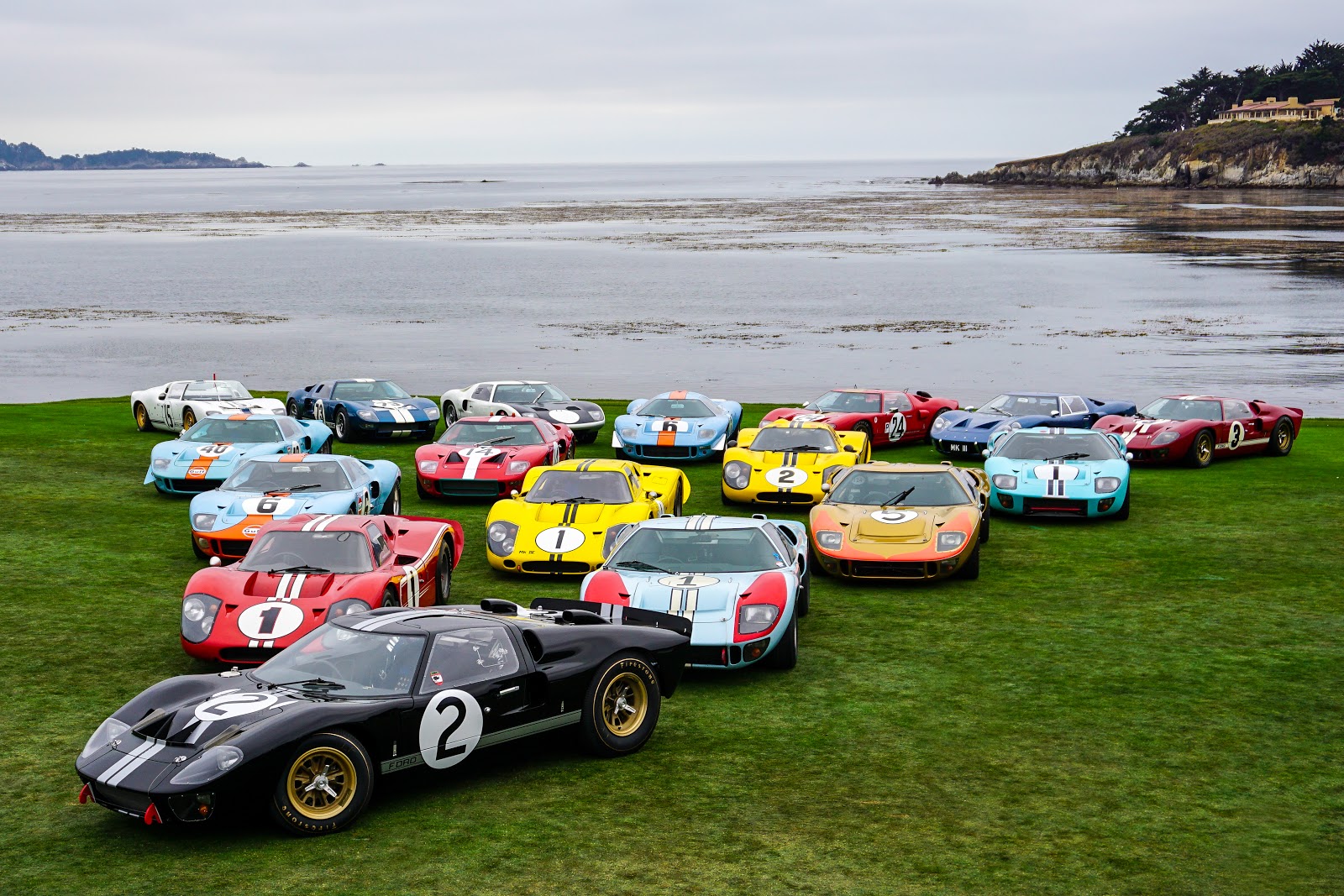
Ford GT40's at Pebble Beach.  Image Credit: 2016 Brandon O'Brien / Motor Driven Images 

The Ford That Beat Ferrari

By: Brandon J. O'Brien 
Images By: Brandon O'Brien / Motor Driven Images unless otherwise specified

In the early 1960's Ferrari dominated international sports racing.  Henry Ford II had a vision to change that by using a V8 engine, an English chassis, and a 40-inch tall body designed in Dearborn. The new car, which arrived in 1964, was dubbed the GT40.  The first 2-years of racing did not go as planned with reliability being the primary issue.  This was to change in 1966 when Ford with the help of Carroll Shelby came to Le Mans that July.  The battle between Ford and Ferrari was to begin in earnest.

In 1966 the Ford GT40 Mk II's finished 1-2-3 at the 24 Hours of Le Mans crushing the winning streak held by Ferrari.  This was the first win by an American constructor and would not be the last.

Now, fifty years later all of the Le Mans winning GT40's and other international sports race winning GT40's were assembled together at Pebble Beach to celebrate the 50th anniversary of that first win.

At the end of the 1964 season the third (GT/103) and fourth (GT/104) prototypes were sent to Carroll Shelby's shop in Los Angeles to have his team refine the chassis.  After months of trial and error testing at Riverside Raceway the car was deemed ready. At Daytona in January 1965 it was clear that Shelby had made a difference when GT/103 scored a victory with Ken Miles and Lloyd Ruby doing the driving.  This car continued to race through the season being driven by other notable drivers such as Bruce McLaren and Phil Hill but did not score another win.

1964 Ford GT Prototype chassis GT/103.   Image Credit: 2016 Brandon O'Brien / Motor Driven Images

Ford Advanced Vehicles (FAV) was set up in England to oversee and develop the GT40 in Europe. Of the five GT40 roadsters produced by FAV chassis GT/109 was the only one to be raced.  It went to Le Mans but like all the GT40's in the 1965 event it failed to finish.

1965 Ford Advanced Vehicles GT Roadster chassis GT/109.  Image Credit:  2016 Brandon O'Brien / Motor Driven Images

Learning from the previous years Ford decided to use the 427 cu.in block in place of the 289 cu.in units. 1966 saw GT40 Mk II (chassis P/1015) starting its career with a win at the 24 hours of Daytona with co-drivers Ken Miles and Lloyd Ruby.

The 1965 Ford GT40 Mk II chassis P/1015 that placed second at the 1966 Le Mans race.  Image Credit: 2016 Brandon O'Brien / Motor Driven Images

From there it went to France. Being driven By Ken Miles and Denny Hulme it was leading during the closing laps of the famed 24-hour event.  A decision was made by Ford to "stage" a photo finish.  Miles slowed the leading GT40 so that the second place GT40 (chassis P/1046) co-driven by Bruce McLaren and Chris Amon could run alongside. When they crossed the finish line in formation the stewards made a controversial decision when they gave the win to the car driven by McLaren/Amon because they had started further down the grid and therefore had driven further than the Miles/Hulme car.

The Le Mans winning 1966 Ford GT40 Mk II chassis P/1046.  Image Credit: 2016 Brandon O'Brien / Motor Driven Images

The third car in that historic finish was driven by Ronnie Bucknum and Dick Hutchinson and was chassis P/1016.

The 1966 3rd place car was this 1965 Ford GT40 Mk II chassis P/1016.  Image Credit: 2016 Brandon O'Brien / Motor Driven Images

In 1967 Ford started campaigning the completely redesigned GT40 Mk IV.  These cars differed from the original Mk I and Mk II GT40's by having longer front facia, lowered Can-Am like tail sections, revised roof lines, and a full NASCAR-style roll cage.  

The Mk IV debuted at Sebring and chassis J-4 led from start to finish while being co-driven by Bruce McLaren and Mario Andretti.  The car was not taken over to Le Mans but it's sister Mk IV (chassis J-5) was and again it bested the best that Ferrari could bring while co-driven by Dan Gurney and A.J. Foyt.

The 1967 Sebring winning Ford GT40 Mk IV chassis J-4.  Image Credit: 2016 Brandon O'Brien / Motor Driven Images

The 1967 Le Mans winning GT40 Mk IV chassis J-5.  Image Credit: 2016 Brandon O'Brien / Motor Driven Images

Although Ford could not claim another 1-2-3 at Le Mans during 1967 another Mk IV (chassis J-6) did finish in 4th place being co-driven by Bruce McLaren and Mark Donohue.  Following the 1967 season Ford decided to retire from international sports racing to focus their efforts elsewhere.  Ford sold FAV to John Wyer and J.W. Automotive Engineering who had managed the racing effort in Europe and along with Alan Mann Racing would continue the fight.

In 1967 this Ford GT40 Mk IV chassis J-6 took 4th place at Le Mans.  Image Credit: 2016 Brandon O'Brien / Motor Driven Images

J.W.Automotive began building two lightweight GT40's with carbon fiber reinforced bodies similar to the Mk. I.  Chassis P/1075 was taken to Le Mans in 1968 being co-driven by Pedro Rodriquez and Lucien Bianchi scoring another victory.  But, this was not the end.  Driven in 1969 by Jacky Ickx and Jackie Oliver they did it again.  This is the only GT40 chassis to win Le Mans two years in a row.

The only GT40 to win Le Mans twice is this 1968 GT40 chassis P/1075.  Image Credit: 2016 Brandon O'Brien / Motor Driven Images

Not all the GT40's present were Le Mans winners.  Chassis P/1031 was raced at Daytona, Sebring, and Le Mans without success.  This was the chassis that Dan Gurney pushed across the finish line in 1966 at Sebring. For some reason after the 1967 Le Mans race and before Reims while being upgraded to Mk IIB status it was re-numbered as chassis P/1047.  Under its new chassis number it was co-driven by Jo Schlesser and Guy Ligier to a 1st place finish at the 12-Hours of Reims. It was retired after the 1967 season.

This Ford GT40 started life in 1965 as chassis P/1031.  In 1967 after upgrading to Mk IIB standards it was changed to chassis P/1047.  Image Credit: 2016 Brandon O'Brien / Motor Driven Images

In 1967 a Mirage Coupe (chassis M1/10003) was driven to victory in the Spa 1000 km race by Jacky Ickx and Dick Thompson.  In 1968 due to FIA rules changes it was converted by J.W. Automotive into a Group 4 GT40 and given chassis number P/1074.  It was one of the three lightweight GT40's built for the J.W.A./Gulf Team.

The Mirage Coupe turned 1968 Ford GT40 chassis P/1074.  Image Credit: 2016 Brandon O'Brien / Motor Driven Images

The most successful GT40 (chassis P AM2) was prepared by Alan Mann Racing for the 1966 season. Although it remained winless that season once converted into Group 4 configuration it competed all over Europe recording as multitude of wins and is still competing successfully in historic motoring events.

1966 Ford GT40 chassis P AM2 was one of two lightweight GT40's prepared by Alan Mann  Racing in 1966.  Image Credit: 2016 Brandon O'Brien / Motor Driven Images

Two other cars were present at Pebble Beach that have no racing heritage but their historical significance allowed their inclusion.  The first is the "tribute" to the very first GT prototype.  The original was built by British specialists Abbey Panels and Harold Radford.  After some development work by Ford in Dearborn the chassis (GT/101) was shown at the 1964 New York Auto Show and then shipped along with the second prototype to Le Mans for the trials.  Both car were crashed there during the trials. GT/101 was then scrapped by Ford and development work on the Mk I was begun.

A Tribute to the original Ford GT Prototype.  Image Credit: 2016 Brandon O'Brien / Motor Driven Images

The second car is the prototype for the road-going GT40 Mk III.  GT40 (chassis M3/1001) was the first of the 31 period road-going GT40's built.

The prototype for the road-going Ford GT40's which were know as Mk III's.  Image Credit: 2016 Brandon O'Brien / Motor Driven Images

So, after fifty years, all of the Le Mans winning GT40's and other international sports race winning GT40's assembled together to celebrate the 50th anniversary of that first win, represented the 2016 Pebble Beach Concours d'Elegance in its full 18th fairway mid-summer motor culture splendor.


TAGS: 2016 Pebble Beach Concours d'Elegance, Alan Mann Racing, Brandon O'Brien, Carroll Shelby, Concours d'Elegance, Ferrari, Ford, GT, GT40, John Wyer, Le Mans, Monterey Car Week, Motor Driven Images, Pebble Beach, Pebble Beach Concours d'Elegance, Shelby